For Organizations
Leadership Transitions
Throughout my career, I have worked with CEOs, founders, physicians, clergy, business owners, and senior leaders navigating complex responsibilities and significant organizational change.
Over time, I began to notice something.
Many accomplished leaders eventually arrive at questions that cannot be answered through performance, achievement, authority, or professional success alone.
Questions of identity.
Questions of purpose.
Questions of contribution.
Questions of legacy.
Questions about who they are becoming beyond the roles they have carried.
The Second Formation™ was developed to provide a thoughtful and structured environment for those conversations.
While not a corporate leadership program, many participants come from senior leadership positions and find the process particularly valuable during seasons of transition, succession, acquisition, retirement planning, organizational change, or personal re-evaluation.
Why Organizations Sponsor Participation
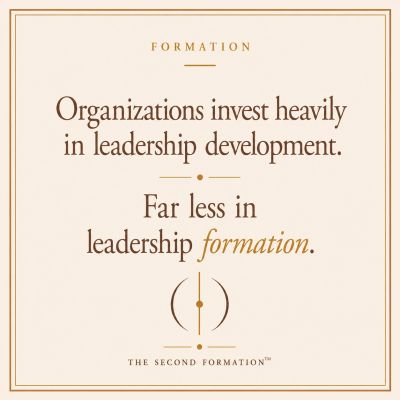
Organizations invest significant resources in developing leadership capability.
Far less attention is given to helping leaders navigate the deeper developmental questions that often emerge during the second half of life.
When these questions remain unexplored, organizations may experience:
- Burnout
- Diminished vitality
- Succession difficulties
- Leadership stagnation
- Retirement resistance
- Founder attachment
- Loss of perspective
- Reduced engagement
When leaders are given space to reflect on identity, purpose, contribution, and legacy, organizations often benefit from:
- Greater leadership maturity
- Healthier succession transitions
- Increased perspective and wisdom
- Renewed engagement
- Improved mentoring and knowledge transfer
- Stronger long-term stewardship
Appropriate Participants
The Second Formation™ may be particularly valuable for:
- CEOs and Presidents
- Founders and Owners
- Senior Executives
- Partners in Professional Firms
- Physicians
- Clergy and Ministry Leaders
- Family Business Leaders
- Individuals approaching significant career or life transitions
Organizational Sponsorship
Organizations occasionally sponsor participation as part of:
- Executive development
- Leadership renewal
- Succession planning
- Founder transition
- Leadership transition support
- Executive retention initiatives
Participation remains confidential and participant-centered.
The purpose is not performance management.
The purpose is human development.
We provide customized human resources solutions tailored to the needs of your business. From recruitment and onboarding to performance management and employee engagement, we can help you build and maintain a high-performing team.
Additional Leadership Consultation
Separate executive coaching, leadership calibration, succession consultation, and organizational advisory services are available for organizations seeking broader leadership support.
For additional information regarding organizational sponsorship or leadership consultation, please contact us directly.
Individual Formation
Personalized service tailored to your unique needs.
Individual Formation™
A private process for accomplished individuals seeking to make sense of the life they have built—and discern what the next chapter may require.
Many people spend decades building a life.
They build careers. Raise families. Lead organizations. Serve communities. Fulfill responsibilities. Become effective, accomplished, and respected.
And for many, there comes a point when success can no longer carry the weight of the questions they are asking.
Not because something has gone wrong.
Because something deeper is asking for attention.
Questions such as:
What has this life taught me?
Who have I become along the way?
What has success given me?
What has it cost me?
What remains unfinished?
What deserves renewed attention?
What is this season of life asking of me?
The Second Formation™ Individual Formation process was created for those questions.
It is a private, structured experience designed to help accomplished individuals reflect upon the life they have lived, recognize what has shaped them, and enter the next chapter with greater clarity, integration, and direction.
You Do Not Need To Be In Crisis
Many participants arrive because life is going well.
Their careers are stable.
Their families are intact.
Their responsibilities are manageable.
They are functioning effectively.
Yet they increasingly recognize that achievement alone can no longer answer the questions they are carrying.
For some, a role is changing.
For others, retirement is approaching.
For many, there is no obvious transition at all.
Only a growing desire to make sense of the life they have built before deciding what comes next.
Why People Come
People often arrive because:
- Life feels successful but something feels unfinished.
- A significant accomplishment has been achieved.
- Children have left home.
- Retirement is approaching.
- A loss has altered perspective.
- A leadership role is changing.
- Long-standing assumptions no longer feel sufficient.
- They want to understand their life more deeply before making important decisions.
- They sense that a different kind of question is emerging.
Most do not arrive seeking answers.
Most arrive seeking understanding.
What Makes This Different?
Most developmental experiences focus on solving problems, improving performance, producing change, or creating a plan.
The Second Formation™ begins somewhere else.
It begins with understanding.
The premise is simple:
People often discover their next chapter not because someone tells them what to do, but because they finally have the opportunity to see their lives more clearly.
The process is grounded in what we call The Discipline of Human Recognition™.
Before people change, they often need to recognize.
Before they recognize, they often need space to pay attention.
The Discipline of Human Recognition™
Many accomplished people spend years receiving feedback, advice, evaluation, instruction, and expectations.
Far fewer experience sustained attention to their actual lives.
The Discipline of Human Recognition™ is built upon a different assumption.
People often gain clarity when they are given the opportunity to reflect honestly upon their experience in the presence of another person who is paying careful attention.
This process is supported by The Art of Accurate Attention™—the disciplined practice of listening carefully enough that meaningful patterns, truths, and insights become visible.
The goal is not to fix.
The goal is not to diagnose.
The goal is not to advise.
The goal is understanding.
The Second Formation™ Journal
At the center of the process is The Second Formation™ Journal.
The Journal is not an assessment.
It is not a workbook.
It is a companion for reflection, writing, and formation.
Participants explore questions related to:
- Early formation and identity
- Achievement and effectiveness
- Authority and responsibility
- Relationships
- Loss and consequence
- Meaning and contribution
- Present life and future direction
Many participants discover that writing itself becomes part of the formative process.
Memories return.
Patterns emerge.
Connections become visible.
The Journal helps create the conditions for those discoveries.
The Process
Individual Formation™ unfolds through four movements.
Taking Stock
Reflecting upon the life that has actually been lived.
Examining formative experiences, relationships, accomplishments, disappointments, responsibilities, and turning points.
Discovering Patterns
Recognizing recurring themes, assumptions, strengths, adaptations, sources of vitality, and sources of depletion.
The objective is not analysis.
The objective is recognition.
Integration
Bringing together the various dimensions of your experience into a more coherent understanding of yourself, your relationships, your work, and your contribution.
Becoming
Entering the next chapter with greater awareness and intention.
Clarifying commitments, relationships, practices, and future direction.
Why Writing Matters
Many important discoveries occur not while speaking, but while writing.
As people slow down and place experience into words, they often begin to see their lives differently.
Forgotten memories return.
Connections become visible.
Assumptions reveal themselves.
Questions deepen.
The Journal is therefore not preparation for the process.
It is part of the process itself.
What We Protect
The atmosphere of Individual Formation™ matters.
We intentionally protect:
- Confidentiality
- Reflection
- Honest conversation
- Participant dignity
- Thoughtful pacing
- Curiosity
- Psychological and relational safety
We intentionally resist:
- Quick answers
- Formulaic solutions
- Performance pressure
- Premature conclusions
- Simplistic interpretations
The work moves at the pace required for meaningful reflection.
What Participants Often Gain
Participants frequently leave with:
- Greater clarity regarding their life story
- Increased understanding of recurring patterns
- A deeper appreciation of important relationships
- Greater awareness of what matters now
- A clearer sense of future direction
- Renewed connection to neglected parts of themselves
- A stronger sense of purpose and contribution
Most importantly, they often leave with a more coherent understanding of the life they have lived and the person they are becoming.
The Formation Charter™
The process culminates in the creation of a personal Formation Charter™.
This is not a strategic plan.
It is not a goal-setting document.
It is a declaration of understanding, intention, and commitment.
The Formation Charter™ captures what participants have learned, what they now understand, what they are reclaiming, what they are releasing, and how they intend to enter the next chapter of life.
For many, it becomes a meaningful companion long after the process concludes.
Who This Is For
Individual Formation™ may be especially meaningful for:
- Executives and senior leaders
- Business owners and entrepreneurs
- Physicians, attorneys, educators, and consultants
- Clergy and ministry leaders
- Individuals approaching retirement
- Individuals reconsidering vocation or contribution
- Accomplished people seeking greater clarity, integration, and direction
Participants do not need to be struggling.
Many arrive because they are ready to engage questions that achievement alone cannot answer.
Format
The standard Individual Formation™ experience includes:
16 private conversations
90 minutes each
Completed over approximately 4–6 months
Supported by The Second Formation™ Journal
Concluding with a Formation Charter™ and Threshold Statement™
Extended and executive formats are also available.
A Personal Note
After more than three decades of working with executives, professionals, clergy, business owners, and leaders, I began noticing a recurring pattern.
Many highly capable people eventually reached a season where achievement no longer answered the questions that mattered most.
Not because they were unsuccessful.
Not because they were lost.
Because life was asking something different of them.
The Second Formation™ emerged from those conversations.
Individual Formation™ exists to provide a thoughtful space for those who wish to make sense of the life they have built and consider what the next chapter may require.
Not Ready Yet?
Sometimes the questions arrive before we are ready to engage them.
That is perfectly acceptable.
The Second Formation™ will still be here when the time is right.
Begin the Conversation
The process begins with a simple conversation.
A conversation about where you are.
The questions you are carrying.
The season you are navigating.
And whether Individual Formation™ may be a helpful next step.
Request an Introductory Conversation
Take stock of the life you have built.
Recognize the person you have become.
Consider the life that may now be emerging.
Proven results that speak for themselves.
Foundations and P.o.V.'s
The Drift of Self
Most people do not wake up one morning and discover they have lost themselves. The process is quieter than that. It happens through years of adaptation, responsibility, sacrifice, and success.
The Drift of Self examines how this occurs—and why recognizing drift may be the beginning of return.
Role Fusion
One of the quiet achievements of adulthood is learning to say: I have a role. I am not my role.
The work of human formation requires us to recover the person beneath the performance, the title, and the expectations of others.
Role Fusion explores what happens when we forget this
and what becomes possible when we remember.
The Discipline of Human Recognition
Most people spend their lives being evaluated, advised, corrected, managed, or fixed.
Very few have the experience of being deeply recognized.
Human recognition is more than being seen. It is the disciplined practice of attending carefully enough to another person's life that they begin to recognize themselves more fully.
In a culture obsessed with performance, speed, and solutions, many accomplished people quietly lose contact with important parts of themselves.
The Discipline of Human Recognition™ explores a different possibility: that accurate, respectful, and compassionate attention may be one of the most transformative experiences available to human beings.
Sometimes people do not need to be fixed.
They need to be recognized.
Making Sense of the Life you Have Built
Many people arrive at midlife or later having built good, meaningful, and successful lives.
Careers have been established. Families have been raised.
Responsibilities have been carried.
Much has been accomplished.
And yet, beneath the visible achievements, new questions often begin to emerge.
- How did I become who I am?
- What patterns have shaped my life?
- What has this life asked of me?
- What remains unfinished, alive, or still calling me forward?
There comes a point in adult life when moving forward requires first looking back.
Not to dwell in the past, but to understand it.
To make sense of the life you have built.
This essay explores why reflection, recognition, and integration may be among the most important tasks of adult development.
Your Leadership Story
You arrived in leadership with a certain wealth.
Experience. Judgment. A way of seeing that has been formed over time.
It’s part of what made you credible enough to lead.
And over time, it begins to shape more than your decisions.
It begins to shape the environment around you.
Often quietly.
Always with impact.
Which is why it matters.
The Soul Behind the Role
We do not need to introduce the word soul to leaders.
They are already using it.
Not in formal settings, not in board decks or quarterly reports, but in the unguarded moments where language becomes honest again:
- “Something about that felt off.”
- “This place has no soul.”
- “I’m exhausted; and it’s not just the hours.”
- “I don’t know… it just didn’t sit right.”
These are not imprecise statements. They are, in fact, remarkably accurate.
Re-membering the Executive
Many executives who struggle are highly capable people who have spent years performing at a high level.
What begins to erode is something more subtle.
The role slowly consumes the person carrying it.
The Trustworthy
"Never the one who doesn't doubt." Old Celtic Proverb
The trustworthy person is not free from uncertainty.
They are free from the illusion that they cannot be wrong.
They pause.
They reconsider.
They ask better questions.
They remain reachable by truth.
“Yeah Murph, but that is not real life.”
The Hidden Danger of Calling Dysfunction “Real Life”
One of the most dangerous moments in organizational life is when people stop believing healthy leadership is realistic.
The moment we begin to imagine healthier systems are possible, we begin recovering the power to help create them.
ABOUT TONY GUARINO

A Personal Note
Over the years, I came to recognize that many of life's most important transitions are not organizational at all.
They are deeply personal.
Again and again, I encountered accomplished men and women who had achieved significant professional success yet found themselves facing a different set of questions:
Who am I beyond the role I have carried for so long?
What has success required of me?
What relationships, interests, or parts of myself have been neglected along the way?
What is this season of life inviting me toward now?
I observed that many of life's most important questions do not emerge during seasons of failure. More often, they arise during seasons of accomplishment.
When professional goals have been achieved and responsibilities mastered, people often discover that achievement alone can no longer carry the weight of their deepest questions. They begin searching for something more—a deeper sense of integration, meaning, contribution, and purpose.
In time, those same questions became important in my own life as well.
Like many others, I found myself reflecting on what had been gained, what had been sacrificed, and what this next chapter of life might ask of me.
That journey of reflection ultimately became one of the inspirations behind The Second Formation™.
I have come to believe that some of the most important work of adulthood begins precisely at the point when life appears successful from the outside, yet something within us quietly asks,
"What now?"

Professional Background
Tony Guarino, MBA
Co-Founder, The Second Formation™
Tony Guarino has spent more than three decades leading organizations, teams, and people through periods of growth, transition, and transformation.
Throughout his career, he has served in senior executive leadership roles across healthcare, pharmaceutical, and technology organizations, guiding complex operations, mergers and acquisitions, organizational integration, and large-scale business growth.
He has led teams of hundreds, partnered with founders, boards, and private equity investors, and helped organizations navigate both opportunity and uncertainty.
As Co-Founder of The Second Formation™, Tony brings the perspective of someone who has lived the demands of leadership while navigating the deeper work of personal reflection and growth.
He understands the pressures of responsibility, the complexity of change, and the challenge of remaining connected to oneself while carrying significant obligations to others.
His presence combines practical wisdom, thoughtful listening, humility, and genuine curiosity about the lives people are living beneath their achievements.
He believes that growth remains possible at every stage of life and that some of the most meaningful development occurs after a person has achieved what they once pursued.
Tony and his wife have spent many years navigating the opportunities, responsibilities, and transitions that accompany leadership, family life, and professional success.
These experiences continue to shape his belief that a meaningful life is built not only through achievement, but through reflection, relationships, contribution, and ongoing formation.
He holds a Master of Business Administration from Suffolk University and a Bachelor of Arts in Political Science from Saint Anselm College.